
Earlier this month, we had the opportunity to attend the 2026 edition of Anthology, the ASEAN architectural festival, in the historic district of Intramuros in Manila.
This year’s festival revolved around the theme Shared Ground, prompting discussions on the architecture of care, culture, and the collective future of Southeast Asia and beyond.
According to festival founder and organiser William Ti Jnr: “Shared ground is a position that reframes architecture as territorial responsibility. The ground becomes the stage upon which competing ambitions play out. Every building touches this ground, and every building alters it. A basement changes groundwater behavior. A podium redirects pedestrian flow. A masterplan restructures access to light, air, and mobility.”
If we are to apply this notion to the practice of tourism on both regional and global levels, the architectural concept of shared ground shifts the focus from creating isolated, luxury destination objects to designing interconnected environments that embrace the local community, ecosystem, and regional geography.
Ti actually points out that architecture does not end at a property line: rather, it acknowledges that the ground in Southeast Asia and the rest of the greater continent is layered, productive, and ecological.
As such, shared ground fundamentally reshapes how destinations are built, experienced, and integrated into the host country.

What exactly does the concept of shared ground entail?
In a hyper-globalised region like Southeast Asia, environmental and economic impacts refuse to stop at national borders.
With regard to the shared ground approach, it recognises that a coastal intervention or infrastructure development in one territory alters the flow of capital, labour, and water systems in another.
For tourism professionals, it is a realisation that cross-border tourism corridors like the Mekong sub-region must be designed collectively.
A shared ground mentality ensures that building a cruise terminal or high-speed rail link considers regional supply chains and migratory realities, shifting the paradigm from national competition to regional ecosystem preservation.

Not quite the end of privatisation
The concept of exclusivity, especially among mega-resorts, commercial enclaves, and gated mixed-use developments in Asia, have essentially sealed off local communities and prevented them from attaining the economic benefits of increased trade and foot traffic into the area.
While the concept of shared ground does not necessarily call for an end to privatisation (and, potentially, gentrification), the principle promotes porosity, essentially edges where the ground level remains a democratic layer.
Instead of separating travellers from locals, designs encourage civic exchange and more open interaction.
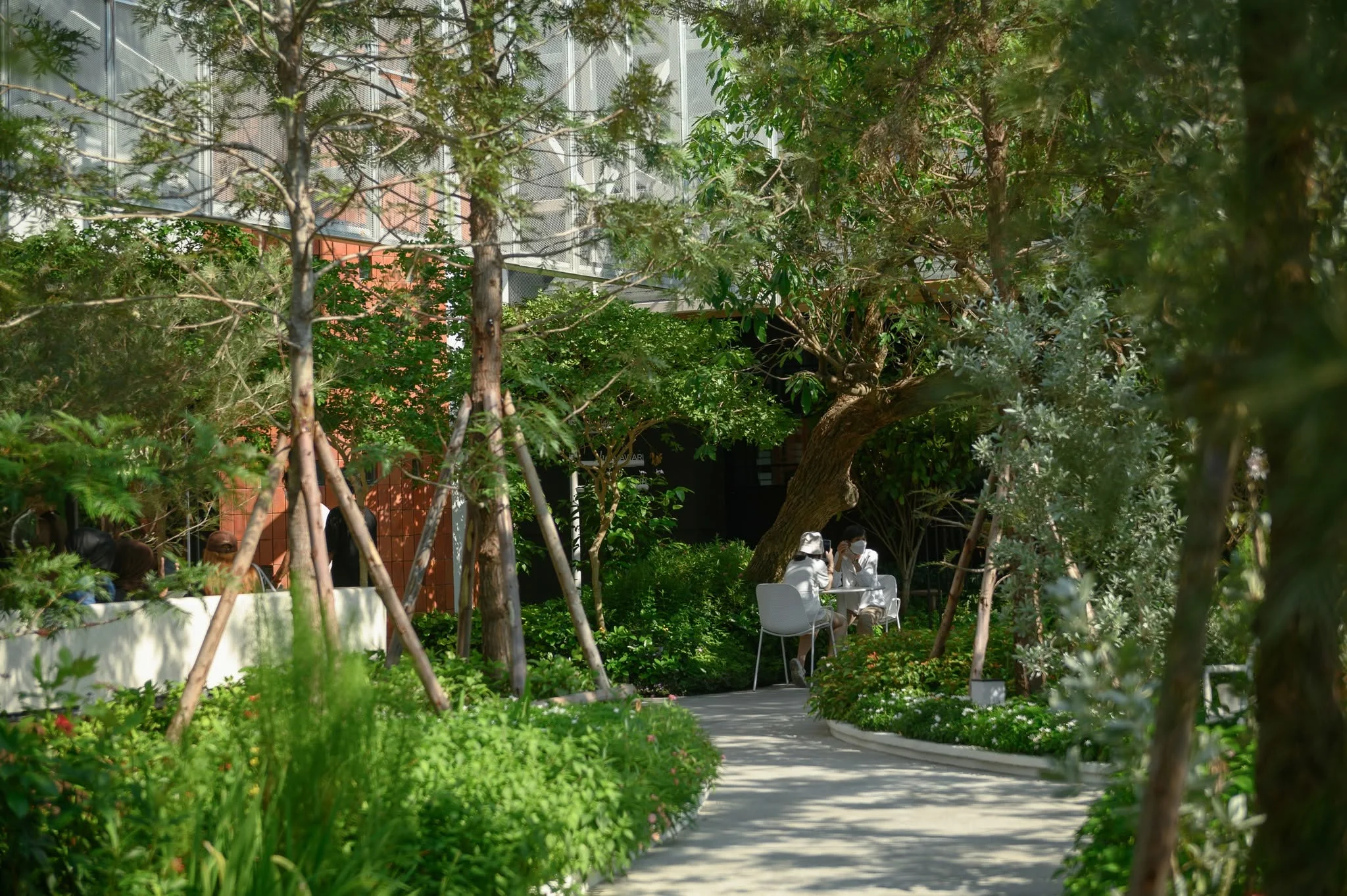
Developments created along those lines feature open, communal hubs, public pathways, and shared backyards that serve as collective spaces where tourists and neighborhoods naturally interact over food, recreation, and culture.
One such development is Kernel Design’s The Ground Bangkok which was created as a dynamic community hub that supports life throughout the day, accommodating a wide range of users and activities.

Where does environmental integration come into play in tourism architecture and design?
Especially now that the world is bearing the brunt of climate change’s worst effects, the ground in Asia is particularly friable, especially because of brutal drought alternating with heavier monsoon rains, super-typhoons, and tidal surges.
In light of these environmental challenges, architecture acts as a form of territorial responsibility rather than a static visual statement.
This has resulted in resorts whose general infrastructure is treated as interventions within living ecological systems.
Firms like WOHA Architects which has handled projects like Alila Villas Uluwatu in Bali and the Pan Pacific Orchard in Singapore; as well as VTN Architects in Vietnam prioritise blending built forms with topography, water retention grids, and local flora.
In their designs, tourism structures actively participate in climate resilience instead of becoming an additional drain on local resources.
I had the opportunity to discuss the matter with a senior Filipino interior designer who shared her thoughts regarding environmental design in accommodations and attractions, and her concern involves making spaces functional as shared ground rather than merely aesthetic.
As she put it: “[In design,] the simpler the better. Instead of wasting the space with plants, put benches so that it won’t be wasted. There should be trees, not shrubs. Especially in certain areas, some fruit-bearing trees are popularly used in public spaces. For example, in Italy, along public walkways, you have orange trees which provide shade and those walking by can pick the fruit; nothing is wasted. Spaces, especially green spaces, must not be hard to maintain after a while.”

What does shared ground mean for heritage sites?
We can say that the shared ground principle brings relief, though not necessarily serves as a panacea, to the effects of rapid urbanisation and commercial tourism.
Too many people and ill-conceived development have historically led to the demolition of heritage sites across cities like Yangon, Jakarta, and Penang.
Applying the principle of shared ground honours the historical layers embedded in the land, including colonial grids, indigenous typologies, and sacred spaces.
At the same time, instead of flattening regional identity to construct standardized modern facilities, the concept champions the adaptive reuse of cultural landscapes.
By filtering vernacular architecture through contemporary design, it counters the commodification of local culture, giving travelers an authentic, deep sense of place rooted in the collective memory of the host community.